
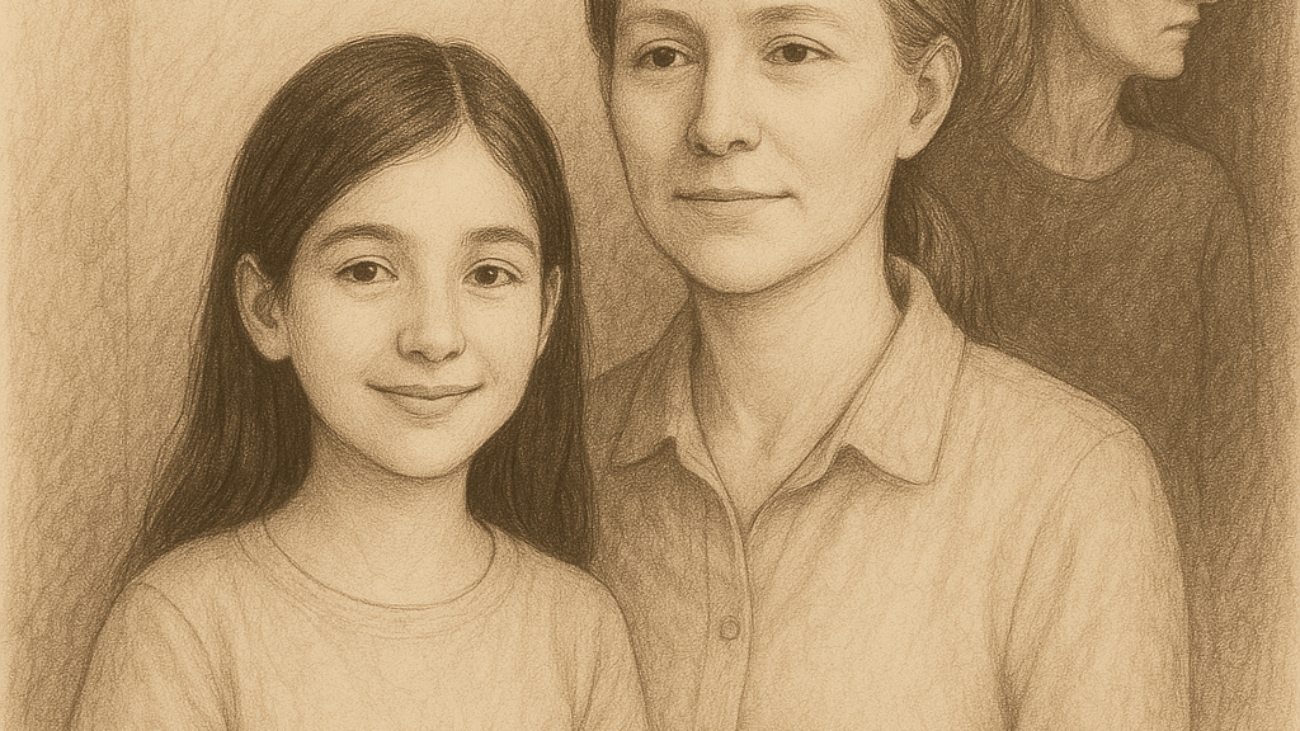
Ilana, who had just turned eleven, sat quietly before me, her face set
with determination and longing. Her smile made it clear—she wanted
something big from me. Her mother, Beth, sat beside her, confident in
her daughter’s resolve and hoping she wouldn’t have to intervene. She
wanted her daughter to handle this herself, with Mom as backup.
I liked them both instantly. Each knew her role—mother and daughter—and
the boundaries those roles entailed. But beyond that, there was a radiant
bond between them. Both were confident in their positions.
“Ilana,” I began after listening to them carefully, “this agency supports
reunions. When an adoption has been through our agency, we go the extra
mile to facilitate it and make it the best experience possible. However, we
have a rule: the adoptee must be 18 before we can, or will, participate.”
Reunions were one of my favorite parts of the job. I had facilitated several,
mostly with adoptees in their late twenties to forties, and they generally
worked out well.
I understood and supported the reasoning behind the age requirement—
and still do, for the most part. But something was different this time. Ilana
had convinced me to bend the rules on her behalf. There was a lot of work
to do, and complicating matters, I was moving to North Carolina in
February. If this were going to happen, I would be the only one to make it
happen.
I knew I was heading for a battle with Grace Sisto, the very old-school head
of Children’s Aid and Adoption Society (CAAS). I was just one step down
from her in the hierarchy, but Grace loved wielding her authority.
Fortunately, I was the direct supervisor of the team involved
in this decision, and I’d always run things democratically. That paid off now.
My team listened because they knew I respected their input. We came to
an agreement, presented our plan to Grace—and we won.
Now came the harder part.
Lisa, Ilana’s birth mother, lived in New York State. She had gone to
college in New Mexico, where she met a young man from the South
Pacific. They dated for several months, and she became pregnant while he
returned home. She returned to New Jersey to have the baby and decided
to work with our agency to surrender her daughter.
Meanwhile, Beth and her husband had spent years trying to start a
family before deciding adoption was their best option. The process is long,
tedious, and often painful—but they faced an additional challenge. They
were Jewish.
There’s a perception that Jewish birth mothers are like unicorns—an
appealing concept, but do they really exist? To complicate things further,
Beth and her husband were religious Conservatives and observant. Though they
had grown up as red diaper babies—liberal in every way—they had chosen
to build a religiously observant home. They kept kosher, celebrated all the
holidays, and even built a sukkah in their backyard for Sukkot.
They worried that even the rare Jewish birth mother would be
uncomfortable with their level of observance. They knew their thoughtfully
chosen path might prevent them from having a family. But Lisa—modern,
Jewish, and perhaps influenced by the fact that her child would be
considered mixed race—agreed to place her baby with them. They weren’t sure of Lisa’s motivations, but they were thrilled to become the parents of
this remarkable baby girl.
There’s a myth that once an infertile couple adopts, they’ll then conceive
naturally. A classmate of mine had an older sister, and we were surprised to
learn she was adopted—but it made sense. They couldn’t have looked
more different. Still, this post-adoption pregnancy phenomenon may be
rarer than Jewish birth mothers.
Yet within seven years of adopting Ilana, Beth gave birth to two boys
and two girls.
We held several meetings with Ilana and Beth to prepare them. One
day, the entire family came in. Ilana’s siblings resembled her. They were all extremely well-
behaved children—but there were five of them, and I was overwhelmed. I had always known Beth was an amazing woman, but that day sealed it.
Lisa, however, was going to be a challenge. She had always been shy,
which came across as cold, and she had no interest in a reunion. She
seemed fearful, and to make matters worse, she was in New York while I
was in Metro New Jersey. In-person meetings weren’t possible; the phone
was our only option. I don’t know how I did it—probably through a
combination of support and concessions—but eventually, we set a date.
She canceled twice because of work.
Time was running out. I was leaving for Raleigh, NC, soon and wouldn’t be
coming back. I got permission to open the agency on a Sunday, and Lisa
agreed to come. She had a young son and needed childcare, but promised
she’d be there.
That Sunday, I woke up and looked out my third-story window—snow.
Heavy snow. NO. Lisa had to drive from New York State in that! I decided
that if she used the weather as an excuse, I would drive up to New York
and drag her down by the hair if I had to.
But she kept her word.
Lisa, Beth, Ilana, Michael (Illana’s father), and I met in a conference
room in an otherwise empty building. Lisa—small and pale, with dishwater
blonde hair—looked nothing like dark-haired, exotic Ilana, who must have
resembled her birth father. Lisa sat apart, arms crossed tightly across her
chest, radiating a clear message: Look, but don’t touch.
Adults are often disappointed because they have expectations about what
should happen. I counsel people about this all the time. So how could an
11-year-old resist that temptation when meeting her birth mother for the first
time?
But this remarkable little girl did just that.
She had a few questions—questions I no longer remember—but she
wasn’t upset about not meeting her little sibling. She had four of those at
home. She wanted to meet her birth mother, and while she only had one of
those, this wasn’t about replacing anyone. Her parents, her siblings, her life
—those were intact. She expected little, received little, and was perfectly
fine with that.
I felt real compassion for Lisa. I saw how much this cost her. Her
coldness wasn’t cruelty—it was protection. She was a very shy woman in a
profoundly difficult situation. And it was working out.
My heart went out to Beth. She had her own reasons for being there.
This woman, Lisa, had not only given her the gift of a daughter, but possibly
the catalyst for the rest of her family. Beth wanted so badly to walk over,
wrap Lisa in an enormous hug, and thank her. But she knew it wouldn’t be
welcomed. So she held back—and watched her daughter blossom.
A few months after I settled in Raleigh, I received a typed, two-page letter
from Ilana. I had always known she was special, but the letter was
beyond her years. She thanked me and said, in essence, that she could
now put this behind her and move forward with her life—which, ultimately,
was what Lisa wanted also.
It’s been more than 32 years since that day.
Beth and I connected on Facebook years ago. I love hearing about her
family. Those five well-behaved children are now successful professionals with their own families. Beth and her husband now have a whole tribe of grandchildren, and I love hearing their stories.
I still think of that day—the spirited little girl and the reserved, shy woman
who brought her into the world. I know that if Lisa had tried to mother
Ilana, one or both of them would not have survived emotionally, certainly
not intact.
In The Ugly Duckling, a swan egg hatches in a duck’s nest. She doesn’t fit
in and goes searching for the flock where she belongs. Ilana was luckier.
She was born into the wrong nest but was quickly placed in the right one—
with a pack of talented, spirited siblings and a father who was perfect for
them all.
Most of all, Ilana found Beth—the woman God must have always
intended to be her mother.