326cf5fd-052a-4210-ba81-b0f892793ae1

Ilana and Beth

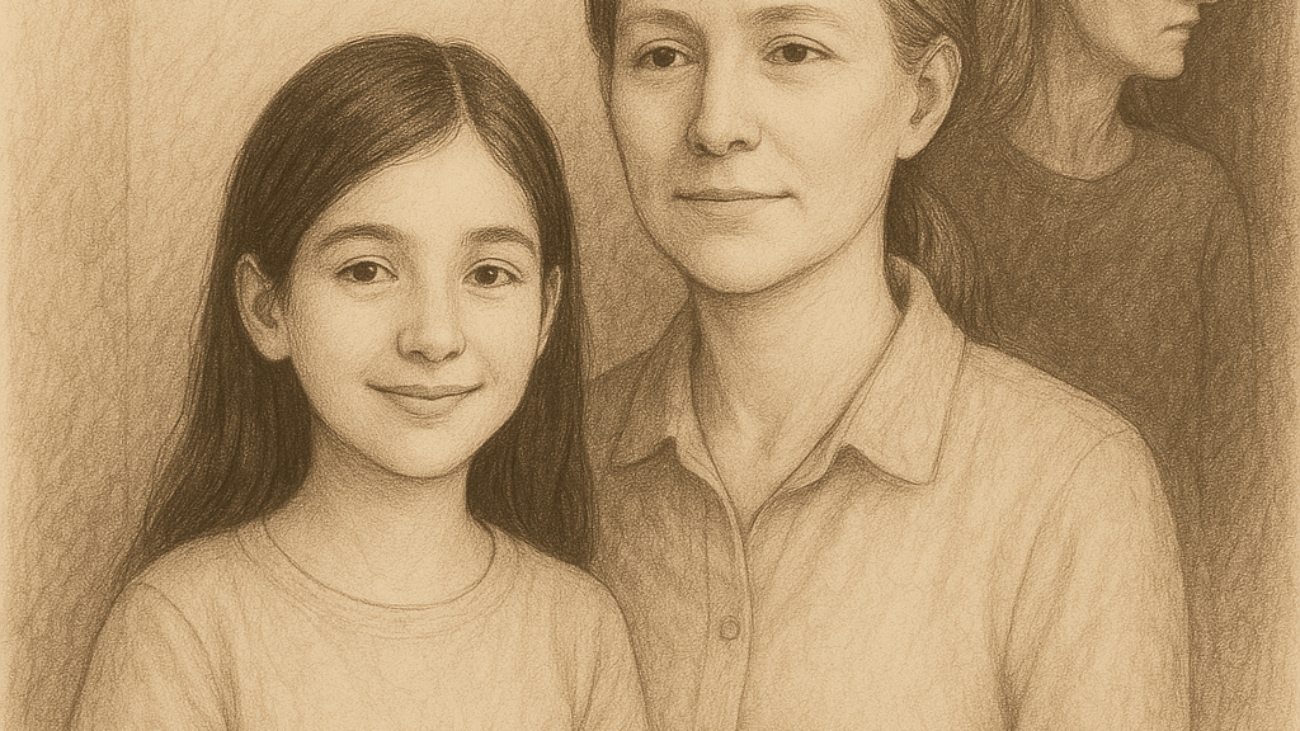
Ilana, who had just turned eleven, sat quietly before me, her face set
with determination and longing. Her smile made it clear—she wanted
something big from me. Her mother, Beth, sat beside her, confident in
her daughter’s resolve and hoping she wouldn’t have to intervene. She
wanted her daughter to handle this herself, with Mom as backup.
I liked them both instantly. Each knew her role—mother and daughter—and
the boundaries those roles entailed. But beyond that, there was a radiant
bond between them. Both were confident in their positions.

“Ilana,” I began after listening to them carefully, “this agency supports
reunions. When an adoption has been through our agency, we go the extra
mile to facilitate it and make it the best experience possible. However, we
have a rule: the adoptee must be 18 before we can, or will, participate.”
Reunions were one of my favorite parts of the job. I had facilitated several,
mostly with adoptees in their late twenties to forties, and they generally
worked out well.

I understood and supported the reasoning behind the age requirement—
and still do, for the most part. But something was different this time. Ilana
had convinced me to bend the rules on her behalf. There was a lot of work
to do, and complicating matters, I was moving to North Carolina in
February. If this were going to happen, I would be the only one to make it
happen.

I knew I was heading for a battle with Grace Sisto, the very old-school head
of Children’s Aid and Adoption Society (CAAS). I was just one step down
from her in the hierarchy, but Grace loved wielding her authority.

Fortunately, I was the direct supervisor of the team involved
in this decision, and I’d always run things democratically. That paid off now.
My team listened because they knew I respected their input. We came to
an agreement, presented our plan to Grace—and we won.

Now came the harder part.

Lisa, Ilana’s birth mother, lived in New York State. She had gone to
college in New Mexico, where she met a young man from the South
Pacific. They dated for several months, and she became pregnant while he
returned home. She returned to New Jersey to have the baby and decided
to work with our agency to surrender her daughter.

Meanwhile, Beth and her husband had spent years trying to start a
family before deciding adoption was their best option. The process is long,
tedious, and often painful—but they faced an additional challenge. They
were Jewish.

There’s a perception that Jewish birth mothers are like unicorns—an
appealing concept, but do they really exist? To complicate things further,
Beth and her husband were religious Conservatives and observant. Though they
had grown up as red diaper babies—liberal in every way—they had chosen
to build a religiously observant home. They kept kosher, celebrated all the
holidays, and even built a sukkah in their backyard for Sukkot.

They worried that even the rare Jewish birth mother would be
uncomfortable with their level of observance. They knew their thoughtfully
chosen path might prevent them from having a family. But Lisa—modern,
Jewish, and perhaps influenced by the fact that her child would be
considered mixed race—agreed to place her baby with them. They weren’t sure of Lisa’s motivations, but they were thrilled to become the parents of
this remarkable baby girl.

There’s a myth that once an infertile couple adopts, they’ll then conceive
naturally. A classmate of mine had an older sister, and we were surprised to
learn she was adopted—but it made sense. They couldn’t have looked
more different. Still, this post-adoption pregnancy phenomenon may be
rarer than Jewish birth mothers.

Yet within seven years of adopting Ilana, Beth gave birth to two boys
and two girls.

We held several meetings with Ilana and Beth to prepare them. One
day, the entire family came in. Ilana’s siblings resembled her. They were all extremely well-
behaved children—but there were five of them, and I was overwhelmed. I had always known Beth was an amazing woman, but that day sealed it.

Lisa, however, was going to be a challenge. She had always been shy,
which came across as cold, and she had no interest in a reunion. She
seemed fearful, and to make matters worse, she was in New York while I
was in Metro New Jersey. In-person meetings weren’t possible; the phone
was our only option. I don’t know how I did it—probably through a
combination of support and concessions—but eventually, we set a date.
She canceled twice because of work.

Time was running out. I was leaving for Raleigh, NC, soon and wouldn’t be
coming back. I got permission to open the agency on a Sunday, and Lisa
agreed to come. She had a young son and needed childcare, but promised
she’d be there.

That Sunday, I woke up and looked out my third-story window—snow.
Heavy snow. NO. Lisa had to drive from New York State in that! I decided
that if she used the weather as an excuse, I would drive up to New York
and drag her down by the hair if I had to.

But she kept her word.

Lisa, Beth, Ilana, Michael (Illana’s father), and I met in a conference
room in an otherwise empty building. Lisa—small and pale, with dishwater
blonde hair—looked nothing like dark-haired, exotic Ilana, who must have
resembled her birth father. Lisa sat apart, arms crossed tightly across her
chest, radiating a clear message: Look, but don’t touch.

Adults are often disappointed because they have expectations about what
should happen. I counsel people about this all the time. So how could an
11-year-old resist that temptation when meeting her birth mother for the first
time?

But this remarkable little girl did just that.

She had a few questions—questions I no longer remember—but she
wasn’t upset about not meeting her little sibling. She had four of those at
home. She wanted to meet her birth mother, and while she only had one of
those, this wasn’t about replacing anyone. Her parents, her siblings, her life
—those were intact. She expected little, received little, and was perfectly
fine with that.

I felt real compassion for Lisa. I saw how much this cost her. Her
coldness wasn’t cruelty—it was protection. She was a very shy woman in a
profoundly difficult situation. And it was working out.

My heart went out to Beth. She had her own reasons for being there.
This woman, Lisa, had not only given her the gift of a daughter, but possibly
the catalyst for the rest of her family. Beth wanted so badly to walk over,
wrap Lisa in an enormous hug, and thank her. But she knew it wouldn’t be
welcomed. So she held back—and watched her daughter blossom.

A few months after I settled in Raleigh, I received a typed, two-page letter
from Ilana. I had always known she was special, but the letter was
beyond her years. She thanked me and said, in essence, that she could
now put this behind her and move forward with her life—which, ultimately,
was what Lisa wanted also.

It’s been more than 32 years since that day.

Beth and I connected on Facebook years ago. I love hearing about her
family. Those five well-behaved children are now successful professionals with their own families.  Beth and her husband now have a whole tribe of grandchildren, and I love hearing their stories.

I still think of that day—the spirited little girl and the reserved, shy woman
who brought her into the world. I know that if Lisa had tried to mother
Ilana, one or both of them would not have survived emotionally, certainly
not intact.

In The Ugly Duckling, a swan egg hatches in a duck’s nest. She doesn’t fit
in and goes searching for the flock where she belongs. Ilana was luckier.

She was born into the wrong nest but was quickly placed in the right one—
with a pack of talented, spirited siblings and a father who was perfect for
them all.

Most of all, Ilana found Beth—the woman God must have always
intended to be her mother.

The Invisible Woman

Can you see me? I’m pretty sure I’m here.
Yet I’m told that at my age — even earlier — women become invisible.

And that we’re supposed to care about that.

I’m told it makes life unhappy, miserable, and barely worth living.

Am I odd because I don’t really notice it?
I like going to the store in “lounge suits,” aka pajamas. Unnoticed? That being invisible is invisible to me?

First, it isn’t totally true.
Do I have trouble getting service? Not really. Of course, I was never one of those girls who attracted gaping stares, so maybe it’s easier for me. Regardless, those days are past.

When I was 40, I climbed to the top of the Mexican pyramid, Chichén Itzá — 215 feet high and very steep — and I was surprised at how easy it was to sprint up it.

At the top, I looked around at the platform where they laid prisoners to cut out their beating hearts before tossing their bodies over the side. But there wasn’t much else to see.

As I went to walk down, I looked down — realizing what a 215-foot, almost sheer drop looked like from the top. I looked back at the platform and thought I could sleep there and beg for snacks from tourists. It was Mexico — how cold could it get at night?     

No kidding. That was my life plan from there on out.

I don’t know how long I stood there before a teenage boy and I noticed each other — both sensing our bond of terror. Somehow, without discussing it, we sat down on the top step and started talking. I don’t remember what about.

Was it encouragement? Maybe.

Using our bottoms, we got each other to the bottom safely. I don’t remember if we even said goodbye — we were so happy to be on flat ground.

If I had gotten along that well with teenage boys when I was in high school, it would have been a very different experience!

Every few years, I think of him. I have no idea if he remembers me at all, but since I only picture a long, skinny shadow, I guess he was invisible to me in a way.

Fast-forward 30 years, and I’m told I’ve become even more invisible.
I’m supposed to care, to be upset about that.

One day, at Ridgewood Shopping Center, walking away from Whole Foods, I was, for some reason, hugging the curb. Not that I needed to — that sidewalk is very wide, with plenty of room — and no one else was there.

I noticed five teenage boys walking toward me, side-by-side, taking up the whole damned sidewalk.
I quickly realized I had four choices:

  1. Keep walking, and when they approach, step into the gutter.

  2. Stop walking and step into the gutter.

  3. Get mad and give them a piece of my mind — make them see me.

  4. Keep walking at my normal pace, ‘stand my ground’ on the curb, and let the chips fall where they may.

I decided on the fourth, having no idea what would happen.
I accepted that I had no control over what my choice would bring — but I chose the one that would not make me unhappy and over which I had control.

I kept walking as they continued to be oblivious to my presence, my approach. I truly was invisible to them.

I searched my brain to see if I had some other agenda.
Was I trying to prove something to them?
I didn’t think so.

I kept walking on the curb, just as I had been before I saw them.

WHAM. BANG.
I felt the pain in my shoulder — the boy on the end and I had crashed hard and loud.

I kept my pace, not looking back, but peripherally I could see him rubbing his shoulder (which I wanted to do, but didn’t), and the other boys looking around in confusion; where did that loud noise come from?

They didn’t see me smile as I continued at my pace.

I don’t even know if I registered with them at all — but what was important was that it didn’t matter to me.
I didn’t need them to “see me.”

I needed to not step into the gutter.

I had decided on a course. I stayed the course.
And I didn’t worry about things I couldn’t control.

  • I didn’t let the scene make me angry. That was something I could control. I controlled it by knowing who I was and what I could and couldn’t do.

  • I didn’t think I had “taught them a lesson.” Maybe I did, but it was doubtful. It didn’t matter. Someday, they might become better people — but that wasn’t up to me. I wasn’t going to make myself unhappy by pretending I could control that.

  • I knew my goal. It was based on what I wanted — and I knew I could control it.

Every few years, I fondly remember that boy back in Mexico.

It doesn’t matter if he remembers me or not, although it’s nice to think that the brief — and so important — connection still lives with him.

One of the boys in Raleigh might have been capable of that kind of collaboration, had he been cut from the herd in which they traveled at the strip mall.

I kept myself in that moment both times.
I knew what I needed and what I could control.

More importantly, I knew what I couldn’t.

That is the secret.

Oh yes — I am not invisible and don’t need anyone else to confirm that.

You don’t disappear when you get old.
Some people may start overlooking you, occasionally — but the most important thing is that you don’t become invisible to yourself.

That you are there for opportunities to relate — when you may need it, say, on Aztec ruins — and that you don’t step off the curb and into the gutter just because other people didn’t see you.

xray-neck-chip-second-vertebre-260nw-2457526195

Difficult Conversations with Doctors Part 1

It was a dark rainy afternoon as I drove past the Wake Tech campus, I started to change lanes, noticed a car approaching at high speed, and tried to go back to the right lane.  My last thought as I tried to keep the JEEP on the road was, “These things are really heavy.”  When I woke up with my head hanging out the broken window, I noticed a crowd standing around the car.  My first thought was, “Good. They will help me get back on the road so I can drive home”.   Then someone threw a blanket over my head, the roof was ripped off, and I was removed with the jaws of life.

They put me on a hard slab and tied me down, I couldn’t move and would stay in that for the next 8 hours until they got the radiologist’s report.   A police officer came to talk to me, said I was called in as a fatality, and gave me a ticket.  The report came, and I was discharged with a clean bill of health.  I was given a script for pain meds, which I never filled, and did a little jig out the door.

I didn’t want my neck to stiffen up, so I stretched it in all directions.  7 days later, I went to my chiropractor, thinking an adjustment would be in order.  He was happy that I had stretched and had not been given a neck brace and said they make things worse.  He took the X-rays from the hospital and went to look at them.  He returned with a small foam neck collar and said, “Stop doing that; put this on; you are going to the hospital; you have a broken neck.”

I was seen by a neurosurgeon who prescribed a very stiff, ungiving neckbrace, which I was to wear 24/7 for the next four months.  I wore it to bed and in the shower, only allowing a minute to change the foam lining.

I was scared and uncomfortable, but I was going to be OK.

My chiropractor showed a colleague the X-rays and asked him to find what someone had missed. The guy looked and looked and said he couldn’t find anything. “What do you mean you couldn’t find anything?” “You said to find what someone missed. No one could have missed that huge chunk out of the second vertebrae.”

Hmmm….  I thought about how someone could have missed it.  All that came to mind was that Dr X could have been drinking or doing drugs.  I was going to be OK.  I was not dead I was not a quadriplegic, but I worried that if this were the case the next person might not do so well.

The letter stated:  Dear Dr X,  First, I want you to know that I am OK; second, I have no intention to sue.  However, we have to talk.

I got a letter from the head of his practice stating that he was board-certified.  That was nice, but we had to talk.  He said he was going on vacation, and would get back to me when he returned.  He didn’t.  In the meantime I I went to Scotland with my neck in an unforgiving trap.  It was so cold there that some days I was glad I had it.

I returned to North Carolina and started my quest. I was clearly being blocked by the head of Dr X’s practice . I decided to go to the next level.  I took off the proverbial gloves

Dear Dr. X: We still need to talk. You have a choice: Either we talk, or the next  letter will be to your licensing board. It’s your choice. I got a call from him. He said he wanted to talk to me four months ago, but his partners wouldn’t let him. It’s good to say, but I would hold judgment to see if it was true or not

Dr. X came to my house right on time. I didn’t tell him, but we met in my office. I was in my shrink’s chair, and he was on the patient’s couch.  I didn’t think it would help to say that.  He started, “We speak our notes into a recorder, and sometimes the transcriber puts them on the wrong x-ray (!) I was really hoping this was the case. But it was the way I talk, it was clearly me.”  He looked at me and said, “I don’t know how it happened”.  He could have left then, I got what I needed.

12-step programs have a saying, “How do you know when an alcoholic or drug addict is lying?  Their lips are moving”.  If he had a problem so bad that he went to work impaired, he would not have said that.  He would have made uo a lie to make himself look good, or at least better.  I felt comfortable that future patients would be as safe as possible given that mistakes can happen with anyone.

It may be hubris on my part, but I think having this time with the patient who should have died or been paralyzed from the neck down was healing for him.  I think I am correct for two reasons.  The first is that while he had made it clear he had an engagement and could only stay 1/2 hour, he stayed two full hours.

We talked about a lot of things.  We talked about hospital policy and what should be changed, we talked about how I could have had a better ER experience and what I could have done.  We talked about my accident and his mistake.  We talked and talked until there was nothing else.

He got up to leave and walked past where I was sitting. He stopped, turned, and went to sit back down.

“I wasn’t going to tell you this.”  This guy had me at ‘It was me, and I don’t know how.’  “I wasn’t going to tell you this, but they didn’t want me to come alone. (I knew that) They wanted me to bring a lawyer or at least one of the partners.”  He looked at me and said, ” But I didn’t think it would be the right thing to do”

Dr X was probably always a good doctor and probably better after this incident.  He was clearly a very decent man. He made a terrible mistake that could have destroyed both of our lives but didn’t.

A June 1, 2015, New York Times article states that doctors who practice defensive medicine are much more likely to be sued.  I have seen articles and studies like this since the 1980s.  However, people like Dr X’s partners continue to try to keep patients at length and never, ever admit to any kind of error.  What a mistake

I’ve been told that getting a doctor who has malpractice against you is hard.  Well, it’s not all that easy, but with perseverance and some knowledge of the system, it’s clearly doable.  Not all doctors are like Dr. X, clearly.

But what if this happened more?  Instead of everyone circling the wagons, what if doctors and patients just talked?  Maybe medicine, in general, would actually get better.  It certainly would be more human.


It doesn’t always work out this way, but there are other ways that we can affect medicine. I will share part 2 of this story in my next post.  If you sign up for notifications, you won’t miss this one.


71FoWj3EdjL._AC_UY436_FMwebp_QL65_-1

American Karma: Twilight of the Marijuana Gods by Doug Shear

A friend gave me this book, and I only read it for that reason.  I owe my friend because otherwise, I wouldn’t have read it.  I thank my friend because there is something about this book, something special.  I wondered if it was just me, but I suggested it to a fellow writer because I thought she could learn techniques from the author.  I was a little nervous about it because she is very different from me, much more conservative, and sees things differently.  I asked her what she thought of it and waited.  The words she used were the same as I would have used.  This book had us seeing things similarly, the same for the first time.

This memoir/novel is the story of a 17-year-old boy trying to find his way in the early 1970s amid drugs and the promise of a phantom hippy Goddess, Mary. He sets out from Miami with his secretly gay best friend to seek her, thinking he will find her.  They make every mistake there is to make.  The humor and pathos had me rooting for this kid as no other boy’s coming-of-age story has.  I have read these stories from the myth of Perseus to the Catcher in the Rye, and they all left me cold.  This true story could have been another in that millennia long tradition, but it isn’t.  That is exactly how the conservative writer described it.

He gave up on finding Mary after obtaining many physical and emotional bruises and returned home to frustrated parents, but not for long. At the time, the notorious pyramid scheme conman Glenn Turner (a hybrid between Bernie Madoff and Donald Trump) was running out of money, about to be prosecuted, and willing to ‘hire’ anyone.  He promised a glorious future if Doug cut his hair and donned a suit. Here is an insider’s account of the fall of a once-successful con. The book is worth reading for the historical content alone.

It was the 1970s, so our young hero also had run-ins at Disney World and with various other savory and not-so-savory characters.

From the Amazon description, bearing the stamp of Doug Shear, “The Marijuana Gods is difficult to believe, but proof exists in the form of letters, objects, and historical evidence. Besides, nobody could make this up.”

I’m not a fan of boy quest stories for many reasons, but partly because they end up self-serving at best.  This book is the exception in my experience. It is easy to root for this kid like no other. 17-year-olds are self-involved, but this one also had a true heart.  When my writer friend came up with the same description almost to the word, I knew that this was a book with universal appeal.

It is well-written and has a unique touch.  The honesty shows what it is like inside a very young man, in a palatable way.  He’s trying to do his best, sometimes comically, often sadly. You will be happy to know that our hero got through it all and became a responsible citizen, mostly.  I most highly recommend this one.


Version 1.0.0

The Barbizon: The Hotel That Set Women Free. by Paula Bren

I came across The Barbizon: The Hotel That Set Women Free by Paula Bren accidentally while reading a discussion on Facebook.  What a treat.  My mother who had never been east of the Mississippi (if you don’t count Moline, Illinois) until she was 54, knew about the Barbizon.  It came up somewhere when I was a kid, and I asked her if she knew about it.  She was also married at 18, and she never wanted to be free, but she knew about this hotel.  This hotel is a part of history.  Whether your interest is in women’s history, the 20th century, feminist history, or the history of Manhattan this is of interest.

Women fought for the vote for decades before they got it in 1920.  Women’s hotels were popping up throughout the country, certainly in Manhattan, but the Barbozon was the last and the star.   They accommodated the women who had been clambering to get out on their own before settling down to marriage.  Many parents would only allow this if their daughters were going to be safe, with restrictions.

In the 1920s and decades after young women graduated college, even the prestigious Seven Sisters had to have secretarial skills if they ever wanted to get a job.  Thus the famous Gibbs Secretarial School had two floors at the Barbizon dedicated to college grads who wanted a job before marriage.  The Powers Modeling agency had a floor.

The residents were upper-class and white and had to supply several references before they were admitted.  The Barbizon had standards.  The rooms were Spartan; however, to the women on their own for the first time, even the rules felt like a freedom they had never dreamed of.  There was luxury Outside the individual rooms, but no men were above the first-floor lobby.

The author did meticulous research about the invisible women who came and went (some never leaving) and a bevy of the famous including Grace Kelly and others you will know.

Sylvia Plath lived there while a Mademoiselle magazine college editor winner in June 1953, as did all the other winners throughout the history of this program. The Bell Jar, Plath’s only novel, begins at this hotel, which she calls the Amazon. Joan Didion wrote there.

It was a dream come true and a place for exploration.  However, Bren also takes us to the downside.  Just as college grads had to go to secretarial school, there was the knowledge that all would get married and desperation among those who were getting too old.  Suicides were relatively common, although they were generally hidden.

We learn about the history of the Mademoiselle program.  Those who grew up reading this magazine and wanting to be part of it will learn what it was like.  We learn about the women who never left, who became a problem in the decades to come.  I enjoyed that when the building was gutted and revamped into condos in the 21st century there were still women there, protected by the New York rent control laws, whose rent could not be raised, could not be moved out, and still had to be provided with complimentary maid service.  These women beat the system.

The book did leave me with a few questions.  We were told often that the only men who ever got above the first floor were doctors, and not just doctors, but gynecologists.  I thought that the only reason women of that age would need that would be abortion, but it wasn’t stated.  Later, she did mention that several women had abortions, but never tied the two together or even discussed it.

There was a chapter titled McCarthyism and Its Female Prey which really piqued my interest.  It seems that those who were obsessed with Communists in our midst also believed that anything that would allow women any freedom was suspect.  I was disappointed with this chapter as it seemed a little shallow.

However, I would highly recommend this book to anyone interested in a well-written history of women in the 20th century, the women’s movement, and New York.


Book Club Questions:

These questions are generally for book clubs; however, they can also be used for contemplation or talking to a friend. Spoiler Alert: These questions are designed for people who have read the entire book. If surprises matter, do not read these now.

  1.  Did the structure of the Barbizon speed up or ultimately hinder the freedom of women during those decades?
  2.  Do you see the links between McCarthyism and feminism, certainly of the time?
  3. Would staying at the Barbizon or a similar residence have helped or hindered you?
  4. Is there a need for a women’s residence today?  Perhaps with fewer rules and restrictions?
Version 1.0.0

The Bell Jar by Sylvia Plath

For decades I assumed that I had read The Bell Jar.  It turns out that I hadn’t.  However, the book is so widely written about that I thought I had.  I had read someone talking about the scene where she goes to a hospital with her medical student boyfriend and watches a birth with the woman in ‘twilight sleep’.  That was seared into my memory.  I decided to reread it when Plath was featured in the book The Barbizon: The Hotel That Set Women Free.  Just as Plath did in real life, the protagonist was awarded the guest editorship of a young women’s magazine.  Like in real life it was glamorous but not as glamorous as young girls would think.

At the end of the month, Esther Greenwood began to have a mental breakdown, but the signs were ignored.  The book is so biographical that Plath originally published it under a pseudonym and only in England to spare the feelings of people she loved who might be upset.

After returning home Esther was able to appear normal, if somewhat worrying, while planning her suicide.  Just as Plath in real life, there was a nationally famous hunt for her after she attempted it until she was found almost dead in her mother’s basement.

I have worked in mental health for more than 40 years, at times with people suffering as she did.  Her portrayal of the inner life was a stunningly intimate portrayal of mental illness and life in the 50s.  Esther was first put in a state facility, after a horrible experience with electroshock.  Thanks to a wealthy benefactor she was then placed in an exclusive private hospital where she recovered.  In addition to the inner workings, we learn a lot about the classist nature of our medical system.

If, like me, you think you have read it because you have read so much about it, it’s time to get the book in your hands. You might want to re-read it regardless, as it is a book that will be important and instructive as you go through ages and changes in your life.

Study Questions

These questions are generally for book clubs; however, they can also be used for contemplation or talking to a friend. Spoiler Alert: These questions are designed for people who have read the entire book. If surprises matter, do not read these now. I have given the entire story of this book because Plath’s life is so well known, and it is her writing that is the reason for reading the book.


  1.   What did you learn about suicide?
  2.   What part of women’s place in society has to do with her breakdown?
  3.   Did the portrayal of her boyfriend seem accurate for male-female relationships of the time?
  4.   How did her mother participate in the problem?  Was she too involved or not enough?
  5.   Plath seemed to draw a link between the electrocution of the Rosenbergs and her own and Esther’s electroshock therapy.  Besides the obvious, what links do you see?


Shutterstock_1168789411 (4)

My Dad, Cats and Cancer

My father hated cats!He was a kind man, but he hated cats.

In the 70s, I moved into an apartment in Montclair, NJ, where no pets were allowed. Through begging I  got permission to get a cat.I returned from the shelter with Betsy, a tiny tabby, Vanessa, a medium calico, and Charlotte, a great big and timid black cat.We lived in a 3 story six-unit tenement, second floor.Every morning, I let them all out to enjoy, and every night, I stood on the back porch, called them, and they ran up the stairs to eat, sleep, and cuddle.

My parents sold their business in San Diego and bought an RV to take a very long vacation, the first they had since they bought their first newspaper in 1948. They were excited, and I was worried knowing they would be visiting me and my three cats a lot.

When in my neighborhood, they squeezed the RV into the alley between my building and the next, spent their days in my place, and slept in the RV.And Dad hated cats.

Luckily, his championship of the underdog, or undercat, was more important than his hatred of cats. When Dad saw how Betsy and Vanessa bullied Charlotte at dinner time, not allowing her her share, he had to do something. He had a plan. He fed them in three bowls, insisting that Charlotte ‘stand her ground.’ He taught her how to eat without fear. Slowly, she learned from him.

I watched the painstaking process.“It’s a good thing you hate cats, or you might get a little carried away here”

After they left, Charlotte’s newfound courage remained for a few weeks, and then slowly, she and they returned to their old ways.  The folks would return twice a year, and Dad would gently put her through the paces again.

This went on for a few years.Charlotte stopped coming home.Occasionally, she came up the back stairs, and we petted her, but it would be weeks in between.Before you think the worst of me, she was fat with a sleek coat and looked great.While I missed her, she had clearly found another home, one without wicked stepsisters to harass her. However, her ears were attuned to the RV engine, which she had heard long before I did, and she would be sitting on the back porch by the time it parked in the alley.There would be a joyous reunion, which Dad pretended not to enjoy. The same lessons repeated.

When the people who bought the business failed, and my parents had to take it back, there would be no more trips.  Eventually, Charlotte stopped coming at all.

Then, one Friday afternoon, the phone rang as I climbed the stairs. It was my mother with some very bad news. I got off work early on Fridays and really wanted to talk with someone, but everyone was at work. I went out to the porch and sat down. Not believing my eyes, I saw Charlotte moseying up the stairs. I hadn’t seen her in two years.

She sat next to me on the stairs.  Feeling very foolish I shrugged, what the heck she was all I had at the moment. “Charlotte, Grandpa has cancer,”I told her what Mom had told me.He had bladder cancer, and Kaiser Permanente had a unique treatment, injecting tuberculosis cancer directly into his bladder.The bladder is so self-contained that this deadly virus could be used to kill cancer but unable to leave; the bladder would starve there after the cancer was gone.With luck, the usual side effects, hair loss, and nausea wouldn’t happen.

There would be 6 treatments.Every Friday Mom called with an update.

Here is where you may think I am crazy, lying, or both, but I am not any of those*. After the next call, still needing to talk, I went out to the porch, feeling very foolish. I mean, last week was a weird coincidence, right? Seriously, I knew that. But I went out, sat down, and here came Charlotte. Each week, I would get the call with the update and go out to the porch, where Charlotte soon joined me and shared the news.

At about halfway his symptoms had gone away, and there were no side effects. Spoiler alert: Dad lived another 25 years, where he died peacefully in his sleep in his bed in my house.

The day I got the last call was bittersweet.Charlotte was waiting for me and I told her the great news.His bladder was clean. Now, Dad would have to be tested once a year for 5 years and then every 5 years for the rest of his life.She listened to all I had to say.

As I watched her waddle down the stairs I knew two things for certain.

First, I knew Dad would be OK and would have many good and productive years.

Second, I knew I would never see Charlotte again.

  • I told the story at an Open Mike in Raliegh.  The MC asked if that really happened. I said my truth, which was “yes”; however, I do not know for sure whether it happened, but this is how I truly remember it.
Portrait,Of,An,Attractive,Middle,Aged,Woman,Looking,Into,A

The Invisable Woman

Can you see me?I am pretty sure I am here.Yet I am told that at my age, even earlier women become invisible.AND that we are supposed to care about that.I am told that it makes my life unhappy, miserable, and barely worth living. Am I odd because I don’t really notice it? I like going to the store in “lounge suits, aka pajamas. Unnoticed? That being invisible is invisible to me?

First, it isn’t totally true.Do I have trouble getting service? Not really. Of course, I was never one of those girls who attracted gaping stares, so maybe it’s easier for me.Regardless those days are past.

When I was 40 I climbed to the top of the Mexican Pyramid, Chicken Itza. 215 feet high and very steep and I was surprised at how easy it was to sprint up it.At the top, I looked around at the platform where they laid prisoners to cut out their hearts before tossing their bodies over the side, but not much else to see, I went to walk down.I looked down, realizing what a 215-foot almost shear drop looked like from up top. I looked back at the platforms and thought I could sleep there and beg for snacks from tourists.It was Mexico, how cold could it get at night? No kidding.That was my life plan from there on out.

I don’t know how long I stood there before a teen-aged boy and I noticed each other, both sensing our bond of terror and somehow, without discussing it we sat down on the top step, started talking to each other I don’t remember about what.  Was it encouragement? Maybe. Using our bottoms, we got each other to the bottom safely.I don’t remember if we even said goodbye we were so happy to be on flat ground.If I had gotten along that well with teenage boys when I was in high school it would have been a very different experience!Every few years, I think of him, and I have no idea if he remembers me at all, but since I only picture a long, skinny shadow, I guess he was invisible to me in a way.

Fast-forward 30 years, and I am told I have become even more invisible. I am supposed to care, to be upset about that.

One day, while at Ridgewood Shopping Center, walking away from Whole Foods, I was, for some reason, hugging the curb. Not that I needed to, as that sidewalk is very wide with plenty of room, and no one else was there.

I notice 5 teenage boys walking toward me, in tandem, taking up the whole damned sidewalk.I quickly realized that I had four choices, 1.Keep walking, and when they approach, step into the gutter.2.Stop walking and step into the gutter.3.Get mad and give them a piece of my mind, making them see me.4. Keep walking at my normal pace while ‘standing my ground’ on the curb. Let the chips fall where they may.

I decided on the 4th, having no idea what would happen. I accepted that I had no control over what my choice would bring. I chose the one that would not make me unhappy and over which I had control.

I kept walking as they continued to be oblivious to my presence, my approach, I truly was invisible to them.I searched my brain to see if I had some other agenda. Was I trying to prove something to them?I didn’t think so.

I kept walking on the curb as I was doing before I saw them.

WHAM BANG. I felt the pain in my shoulder, the boy on the end, and I had crashed hard.I kept my pace, not looking back, but peripherally I could see him rubbing his shoulder (which I wanted to do, but didn’t) and the other boys looking around in confusion.

They didn’t see me smile as I continued at my pace.I don’t even know that I registered with them at all, but what was important was that it didn’t matter to me.I didn’t need them to “see me”. I needed to not step into the gutter.

I had decided on a course, I stayed the course, and I didn’t worry about things that I couldn’t control

  1.  I didn’t let the scene get me angry.That was something I could control.I controlled it by knowing who I was and what I could and couldn’t do.

      2.I didn’t think I had “taught them a lesson.” Maybe I did, but it was doubtful. It didn’t matter. Someday, they might become better people, but that wasn’t up to me, and I wasn’t going to make myself unhappy by pretending that I could control that.

      3.I knew my goal, and it was based on what I wanted, and I knew I could control it.


Every few years, I fondly remember that boy back in Mexico. It doesn’t matter if he remembers me or not, although it’s nice to think that that brief and so important connection still lives with him. One of the boys in Raleigh might have been capable of that kind of collaboration had he been cut from the herd in which they traveled at the strip mall.

I kept myself in that moment both times.I knew what I needed and what I could control. And more importantly, what I couldn’t.

That is the secret.Oh, yes, I am not invisible and don’t need anyone else to confirm that. You don’t disappear when you get old.Some people may start overlooking you, occasionally, but the most important thing is that you don’t become invisible to yourself, that you are there for opportunities to relate when you may need it on, say, Aztec ruins, and that you don’t step off the curb and into the gutter because other people didn’t see you.

81mLN5PmpdL._AC_UY436_FMwebp_QL65_

The Change by Kirsten Miller

I discovered this book after a friend recommended it. Thank you, Lori! That is the best way to find great books, isn’t it?

I bought it and had it for a while before reading it, then couldn’t put it down. Just before I read it, I found Unlikeable Female Characters by Anna Bogutskaya. It was a perfect follow-up that helped me put the women in The Change into real context. From “Unlikeable,” “It’s not about relatability; it’s about permission to fail and be flawed.”

These women are flawed, and I don’t know if I liked them very much, but Anna Bogutskaya helped me see that I don’t have to like them to cheer them and know that everything they did wrong was right. I don’t have to want to be friends with them to really appreciate their story.

According to the back cover, Nessa is the Seeker, who has inherited the ability to see ghosts and must help them. Harriet is the Punisher, who has stopped caring about what anyone thinks, and Jo is the Protector, mad as hell and isn’t taking it anymore. All are a bit over the top, and I don’t want to be friends with any of them, but I cheered them on throughout the book.

Briefly, Nessa, having entered menopause, was seeing ghosts, ghosts of dead girls.  She and her partners had to find the bodies and revenge their murders in order for these girls to be free.  No small task and one that required radical action, even unlikeable action.

It is fast-paced, even when seemingly breaking up the story to give back story.  Occasionally, it was unsettling, but it always worked out.  The technique gave a breather to an otherwise intense narrative but was never gratuitous.  There was a method for it all.

I wonder how much of her story she got from the Jeffery Epstein story. I won’t say more as it might be a spoiler, and any connections may be in my head.  You decide for yourselves.

The characters are well fleshed out, even the relatively insignificant ones whose purpose is to advance the story.  And the story pulls no punches.  Fiction is a great place for moral ambiguity, especially when it seems so right.

I must add that there are good men in this very feminist revenge book. Guys even get better as the women become more powerful. There are some really likable men!


Study Questions

These questions are generally for book clubs; however, they can be used for contemplation or talking to a friend.  Spoiler Alert: These questions are designed for people who have read the entire book.  If surprises matter, do not read these now.   If you have a question you would like to discuss, put it in the comments.  Thanks

  1.  Jo’s anger leads to violence, and Harriett’s anger is displayed much differently.  Discuss the difference. Is one more moral than the other?  Which would you be more likely to follow?
  2. The three protagonists are all menopausal.  Nessa’s twins are in full childbearing age and Jo’s daughter is still prepubescent.  Nessa got her power before her period and was told it would go away until menopause.  Why do you think that might have been necessary?  If you do.
  3. There are three daughters in the story.  Mothers and daughters represent 3 stages of female fertility.  how do they fit in?
  4. What was the change in Jo’s husband about?  Did it seem real to you?  Why did it happen when it did?
  5. If this book were made into a movie (and lets hope it is) Would Nessa, Jo and Harriett be ‘unlikeable women” and if so, what kind?