
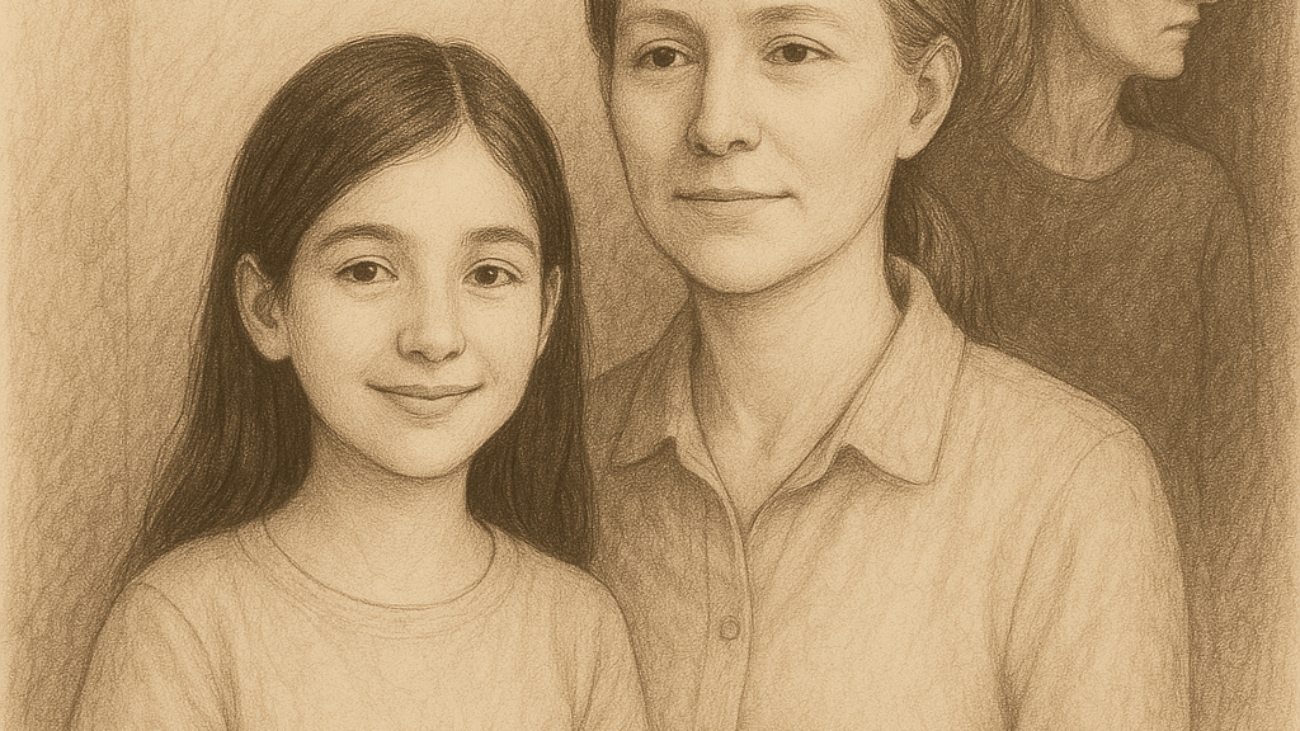
326cf5fd-052a-4210-ba81-b0f892793ae1

Ilana and Beth

Ilana, who had just turned eleven, sat quietly before me, her face set
with determination and longing. Her smile made it clear—she wanted
something big from me. Her mother, Beth, sat beside her, confident in
her daughter’s resolve and hoping she wouldn’t have to intervene. She
wanted her daughter to handle this herself, with Mom as backup.
I liked them both instantly. Each knew her role—mother and daughter—and
the boundaries those roles entailed. But beyond that, there was a radiant
bond between them. Both were confident in their positions.

“Ilana,” I began after listening to them carefully, “this agency supports
reunions. When an adoption has been through our agency, we go the extra
mile to facilitate it and make it the best experience possible. However, we
have a rule: the adoptee must be 18 before we can, or will, participate.”
Reunions were one of my favorite parts of the job. I had facilitated several,
mostly with adoptees in their late twenties to forties, and they generally
worked out well.

I understood and supported the reasoning behind the age requirement—
and still do, for the most part. But something was different this time. Ilana
had convinced me to bend the rules on her behalf. There was a lot of work
to do, and complicating matters, I was moving to North Carolina in
February. If this were going to happen, I would be the only one to make it
happen.

I knew I was heading for a battle with Grace Sisto, the very old-school head
of Children’s Aid and Adoption Society (CAAS). I was just one step down
from her in the hierarchy, but Grace loved wielding her authority.

Fortunately, I was the direct supervisor of the team involved
in this decision, and I’d always run things democratically. That paid off now.
My team listened because they knew I respected their input. We came to
an agreement, presented our plan to Grace—and we won.

Now came the harder part.

Lisa, Ilana’s birth mother, lived in New York State. She had gone to
college in New Mexico, where she met a young man from the South
Pacific. They dated for several months, and she became pregnant while he
returned home. She returned to New Jersey to have the baby and decided
to work with our agency to surrender her daughter.

Meanwhile, Beth and her husband had spent years trying to start a
family before deciding adoption was their best option. The process is long,
tedious, and often painful—but they faced an additional challenge. They
were Jewish.

There’s a perception that Jewish birth mothers are like unicorns—an
appealing concept, but do they really exist? To complicate things further,
Beth and her husband were religious Conservatives and observant. Though they
had grown up as red diaper babies—liberal in every way—they had chosen
to build a religiously observant home. They kept kosher, celebrated all the
holidays, and even built a sukkah in their backyard for Sukkot.

They worried that even the rare Jewish birth mother would be
uncomfortable with their level of observance. They knew their thoughtfully
chosen path might prevent them from having a family. But Lisa—modern,
Jewish, and perhaps influenced by the fact that her child would be
considered mixed race—agreed to place her baby with them. They weren’t sure of Lisa’s motivations, but they were thrilled to become the parents of
this remarkable baby girl.

There’s a myth that once an infertile couple adopts, they’ll then conceive
naturally. A classmate of mine had an older sister, and we were surprised to
learn she was adopted—but it made sense. They couldn’t have looked
more different. Still, this post-adoption pregnancy phenomenon may be
rarer than Jewish birth mothers.

Yet within seven years of adopting Ilana, Beth gave birth to two boys
and two girls.

We held several meetings with Ilana and Beth to prepare them. One
day, the entire family came in. Ilana’s siblings resembled her. They were all extremely well-
behaved children—but there were five of them, and I was overwhelmed. I had always known Beth was an amazing woman, but that day sealed it.

Lisa, however, was going to be a challenge. She had always been shy,
which came across as cold, and she had no interest in a reunion. She
seemed fearful, and to make matters worse, she was in New York while I
was in Metro New Jersey. In-person meetings weren’t possible; the phone
was our only option. I don’t know how I did it—probably through a
combination of support and concessions—but eventually, we set a date.
She canceled twice because of work.

Time was running out. I was leaving for Raleigh, NC, soon and wouldn’t be
coming back. I got permission to open the agency on a Sunday, and Lisa
agreed to come. She had a young son and needed childcare, but promised
she’d be there.

That Sunday, I woke up and looked out my third-story window—snow.
Heavy snow. NO. Lisa had to drive from New York State in that! I decided
that if she used the weather as an excuse, I would drive up to New York
and drag her down by the hair if I had to.

But she kept her word.

Lisa, Beth, Ilana, Michael (Illana’s father), and I met in a conference
room in an otherwise empty building. Lisa—small and pale, with dishwater
blonde hair—looked nothing like dark-haired, exotic Ilana, who must have
resembled her birth father. Lisa sat apart, arms crossed tightly across her
chest, radiating a clear message: Look, but don’t touch.

Adults are often disappointed because they have expectations about what
should happen. I counsel people about this all the time. So how could an
11-year-old resist that temptation when meeting her birth mother for the first
time?

But this remarkable little girl did just that.

She had a few questions—questions I no longer remember—but she
wasn’t upset about not meeting her little sibling. She had four of those at
home. She wanted to meet her birth mother, and while she only had one of
those, this wasn’t about replacing anyone. Her parents, her siblings, her life
—those were intact. She expected little, received little, and was perfectly
fine with that.

I felt real compassion for Lisa. I saw how much this cost her. Her
coldness wasn’t cruelty—it was protection. She was a very shy woman in a
profoundly difficult situation. And it was working out.

My heart went out to Beth. She had her own reasons for being there.
This woman, Lisa, had not only given her the gift of a daughter, but possibly
the catalyst for the rest of her family. Beth wanted so badly to walk over,
wrap Lisa in an enormous hug, and thank her. But she knew it wouldn’t be
welcomed. So she held back—and watched her daughter blossom.

A few months after I settled in Raleigh, I received a typed, two-page letter
from Ilana. I had always known she was special, but the letter was
beyond her years. She thanked me and said, in essence, that she could
now put this behind her and move forward with her life—which, ultimately,
was what Lisa wanted also.

It’s been more than 32 years since that day.

Beth and I connected on Facebook years ago. I love hearing about her
family. Those five well-behaved children are now successful professionals with their own families.  Beth and her husband now have a whole tribe of grandchildren, and I love hearing their stories.

I still think of that day—the spirited little girl and the reserved, shy woman
who brought her into the world. I know that if Lisa had tried to mother
Ilana, one or both of them would not have survived emotionally, certainly
not intact.

In The Ugly Duckling, a swan egg hatches in a duck’s nest. She doesn’t fit
in and goes searching for the flock where she belongs. Ilana was luckier.

She was born into the wrong nest but was quickly placed in the right one—
with a pack of talented, spirited siblings and a father who was perfect for
them all.

Most of all, Ilana found Beth—the woman God must have always
intended to be her mother.

xray-neck-chip-second-vertebre-260nw-2457526195

Difficult Conversations with Doctors Part 1

It was a dark rainy afternoon as I drove past the Wake Tech campus, I started to change lanes, noticed a car approaching at high speed, and tried to go back to the right lane.  My last thought as I tried to keep the JEEP on the road was, “These things are really heavy.”  When I woke up with my head hanging out the broken window, I noticed a crowd standing around the car.  My first thought was, “Good. They will help me get back on the road so I can drive home”.   Then someone threw a blanket over my head, the roof was ripped off, and I was removed with the jaws of life.

They put me on a hard slab and tied me down, I couldn’t move and would stay in that for the next 8 hours until they got the radiologist’s report.   A police officer came to talk to me, said I was called in as a fatality, and gave me a ticket.  The report came, and I was discharged with a clean bill of health.  I was given a script for pain meds, which I never filled, and did a little jig out the door.

I didn’t want my neck to stiffen up, so I stretched it in all directions.  7 days later, I went to my chiropractor, thinking an adjustment would be in order.  He was happy that I had stretched and had not been given a neck brace and said they make things worse.  He took the X-rays from the hospital and went to look at them.  He returned with a small foam neck collar and said, “Stop doing that; put this on; you are going to the hospital; you have a broken neck.”

I was seen by a neurosurgeon who prescribed a very stiff, ungiving neckbrace, which I was to wear 24/7 for the next four months.  I wore it to bed and in the shower, only allowing a minute to change the foam lining.

I was scared and uncomfortable, but I was going to be OK.

My chiropractor showed a colleague the X-rays and asked him to find what someone had missed. The guy looked and looked and said he couldn’t find anything. “What do you mean you couldn’t find anything?” “You said to find what someone missed. No one could have missed that huge chunk out of the second vertebrae.”

Hmmm….  I thought about how someone could have missed it.  All that came to mind was that Dr X could have been drinking or doing drugs.  I was going to be OK.  I was not dead I was not a quadriplegic, but I worried that if this were the case the next person might not do so well.

The letter stated:  Dear Dr X,  First, I want you to know that I am OK; second, I have no intention to sue.  However, we have to talk.

I got a letter from the head of his practice stating that he was board-certified.  That was nice, but we had to talk.  He said he was going on vacation, and would get back to me when he returned.  He didn’t.  In the meantime I I went to Scotland with my neck in an unforgiving trap.  It was so cold there that some days I was glad I had it.

I returned to North Carolina and started my quest. I was clearly being blocked by the head of Dr X’s practice . I decided to go to the next level.  I took off the proverbial gloves

Dear Dr. X: We still need to talk. You have a choice: Either we talk, or the next  letter will be to your licensing board. It’s your choice. I got a call from him. He said he wanted to talk to me four months ago, but his partners wouldn’t let him. It’s good to say, but I would hold judgment to see if it was true or not

Dr. X came to my house right on time. I didn’t tell him, but we met in my office. I was in my shrink’s chair, and he was on the patient’s couch.  I didn’t think it would help to say that.  He started, “We speak our notes into a recorder, and sometimes the transcriber puts them on the wrong x-ray (!) I was really hoping this was the case. But it was the way I talk, it was clearly me.”  He looked at me and said, “I don’t know how it happened”.  He could have left then, I got what I needed.

12-step programs have a saying, “How do you know when an alcoholic or drug addict is lying?  Their lips are moving”.  If he had a problem so bad that he went to work impaired, he would not have said that.  He would have made uo a lie to make himself look good, or at least better.  I felt comfortable that future patients would be as safe as possible given that mistakes can happen with anyone.

It may be hubris on my part, but I think having this time with the patient who should have died or been paralyzed from the neck down was healing for him.  I think I am correct for two reasons.  The first is that while he had made it clear he had an engagement and could only stay 1/2 hour, he stayed two full hours.

We talked about a lot of things.  We talked about hospital policy and what should be changed, we talked about how I could have had a better ER experience and what I could have done.  We talked about my accident and his mistake.  We talked and talked until there was nothing else.

He got up to leave and walked past where I was sitting. He stopped, turned, and went to sit back down.

“I wasn’t going to tell you this.”  This guy had me at ‘It was me, and I don’t know how.’  “I wasn’t going to tell you this, but they didn’t want me to come alone. (I knew that) They wanted me to bring a lawyer or at least one of the partners.”  He looked at me and said, ” But I didn’t think it would be the right thing to do”

Dr X was probably always a good doctor and probably better after this incident.  He was clearly a very decent man. He made a terrible mistake that could have destroyed both of our lives but didn’t.

A June 1, 2015, New York Times article states that doctors who practice defensive medicine are much more likely to be sued.  I have seen articles and studies like this since the 1980s.  However, people like Dr X’s partners continue to try to keep patients at length and never, ever admit to any kind of error.  What a mistake

I’ve been told that getting a doctor who has malpractice against you is hard.  Well, it’s not all that easy, but with perseverance and some knowledge of the system, it’s clearly doable.  Not all doctors are like Dr. X, clearly.

But what if this happened more?  Instead of everyone circling the wagons, what if doctors and patients just talked?  Maybe medicine, in general, would actually get better.  It certainly would be more human.


It doesn’t always work out this way, but there are other ways that we can affect medicine. I will share part 2 of this story in my next post.  If you sign up for notifications, you won’t miss this one.


Portrait,Of,A,Sleeping,Woman

Witch Trials and Penis Envy

Mary and Rhoda (their real names) were the training supervisors during my first year in grad school.  There were 20 students from three different metro schools.  I was lucky to have Mary, who was both intelligent and warm.  Rhoda may have known her stuff, but she was hard.  Her students complained, and Mary’s supervisees thought Rhoda ruined the weekly staff meeting.  I volunteered to speak up at the next meeting, and they all said they would back me.  I spoke up and was left alone to face Rhoda’s wraith.  They meant well, but she was scary.

Jeff, a fellow Hunter student, explained this (mansplaining?) “Look, she’s old and past her sexual desirability, in her 50s (so was Mary, BTW) and you are still young enough (I was 32) to have the sexual energy.”  I was very uncomfortable with his describing me that way; maybe he thought he had the right to do it, or assumed I would be flattered. I was mostly bothered that he reduced Rhoda’s nasty demeanor to being an envious old woman.  I argued with him, but of course, he was right, dontcha know.

*******

Throughout the hundreds of years of witch trials in Europe and America, being old was often considered a crime worthy of a witch trial.  Being old and not sexy meant a woman would be malevolent unless she were too sexy, which was also dangerous.

The history of witchcraft in 17th-century America includes trial by water.  Throw a suspected witch into a pond. If she is a witch, the pure waters will reject her, and she will float to the top and be executed.  If she was innocent, they tried and usually failed to get her out before she ceased breathing. 

Fast-forward to the late 20th century. After grad school, I attended one of the ubiquitous post-grad therapy institutes in the greater NY metro. Mine was eclectic, covering mostly the British School of Object Relations, Kohutian Self Psychology, and the like. Forty years later, I am grateful for what I learned there and have integrated most of it into my work, which today includes cognitive and behavioral work. I just wish they had taught Jung.

The entire faculty acknowledged Freud as the father of psychoanalysis, which is what we were being taught.  They revered him with no worship.  My favorite supervisor, Manny, once said to me, “I wonder if penis envy exists for women, I know men have it, but do women?”

We had two faculty members and one student who were total believers.  Penis envy is not just curiosity or the desire to have one, wishing that appendage was forever attached for the advantages, no.  Penis envy works this way:  Girls are happy with themselves until they view a penis.  It doesn’t matter what age she is; as soon as she sees one, she is thrown into the depths of despair, inferiority, and shame, which will guide everything in her life forever.  Her only chance is a good analyst who will help her recognize and admit to this so she can get on with life as a lesser, but mature being.  A woman’s maturity and mental health depend on her acknowledging her inferiority because of a body part. There you go, ladies, that explains it all. Don’t argue or even think about it.

Back to witches.  Dr. Bob M.  was a true believer.  I made the mistake of asking, “What about females with no brothers who never saw a penis until adulthood?”  Instantly I had floated to the top of his pond, I could vision him angrily pointing his index finger at me as he ‘calmly’  stated that what I just said was proof of penis envy. (Mine or his?) I knew better than to mention that older sisters often wanted to know what was wrong with their baby brothers.  I didn’t mention my college roommate, Lucy, who told the funny story of her brother’s birth.  She and her older sister, Linda, cried and wanted to know what was wrong with their new baby brother.  To Dr. Bob, they would have been resistant to seeing their own envy and at 2 and 3 were covering it.

The student was Dr Jim,  a PhD and the only male in our group of 5 with four female social workers.  When we were handed reading assignments from psychoanalytic journals, he would question if the class, including himself, was up to reading this. We ‘girls’ just read and discussed while he worried. He also had his proof.  The story was that a girl got her first period, her mother said she would get her a pad, the girl thought she said ‘pan’ and since pans have handles which are phallic symbols, well, you know the rest.

Having learned my lesson, I never mentioned that little kids, boys, and girls usually thought that people with unusual growths, such as warts, were gross, not something to be envied or feel inferior to, but as I said, that lake was cold.

Dr. Susan was an instructor so easy to ridicule or parody that describing her fills me with guilt. As an older teen, she was in analysis with a man who later became a widower. Susan then married him and mothered his son, having no children of her own. She often came to class in a red blazer, white blouse, and pleated skirt, looking very much like a Catholic schoolgirl and not the sexy kind.

Our classes consisted of her teaching us that every woman’s destiny was penis envy and mental health was admitting that and accepting the role that came with it.

I set up a small conference for area therapists.  These were the days when everything was done by mail.  Dr. Susan signed up to teach one seminar on penis envy, of course.  When the applications were returned, only 5 women signed up; that was “proof” that all women suffered.  There were two sessions with three options.  Hers was in the first group, and she planned to be driven back to the city immediately after. While other presenters attended other sessions, she had no intention of doing that.   When none of those who signed up attended her class, she gracelessly sat in the hall, pouting,  until she was taken home rather than attend someone else’s.   The saving grace for her was that she had more “proof”

One day in class, someone presented a case.  Her patient’s husband demanded and would only have oral sex.  I did ask if it was reciprocal, and no, it wasn’t.   Dr. Susan and I were both getting hot under the collar about it.  Wow, could it be that we agreed on something? I was annoyed by the selfishness.  Her problem, however, was that the woman was infantilizing her husband by not insisting on intercourse, and thus she was castrating him, which, wait for it, was proof of …..Penis Envy!    Witches were accused of stealing men’s penises, even though none ever went missing.  The water was getting colder.

This is well in my past, and I can joke about it.  Most of my institution’s people, students, and instructors paid no attention to it.  I used the valuable information from the sources that made sense and left the rest.

Recently, I got a new patient, a woman in her 70s who grew up as the second daughter of a large Catholic family in the northeast.  Her father worked during the day and went to the bar with his friends at night, coming home long enough to make another baby. Her sister had left by the time her mother got cancer, leaving her to care for the mother and younger siblings by herself.  After her mother died, the kids were her responsibility.  She went to the priest for help. He angrily told her that her father was a good Catholic man who made a lot of babies, and she would go to Hell for talking badly about him.

Fortunately, she did see a psychiatrist who told her that if she didn’t leave and move in with her sister, he would have her committed to a mental hospital.  That was in the day when a commitment would be months or years.  She went to her sister’s.

She got married and had a couple of kids, but her life was a struggle to escape her upbringing mentally.  She had gone into therapy with a woman while in her 30s in New York hoping to get rid of this past and the trauma from a rape when she was a child.  She hoped that she would get help.

She found a woman therapist who spent 2 years and 9 months talking to her about her “penis envy.”

And suddenly I stopped laughing, it wasn’t amusing at all.